The Powerhouse Plunge
A Trail Built by Community, Defended by Passion, Reborn for the Future
Origins: A Race and a Recce
The Powerhouse Plunge was born from the ambition of a few visionary riders who wanted to build something that had never been done in Squamish, British Columbia. In 1995, Kevin McLane had a plan: a 67-kilometre point-to-point mountain bike race unlike anything the sport had seen. It would be called the Test of Metal. The course would sweep north from the Squamish Civic Centre in downtown Squamish, climbing through the streets of Garibaldi Highlands like a European road race, looping through the Alice Lake area, pushing up the Garibaldi Park Road and Mamquam FSR, crossing Ring Creek, and descending through Crumpit Woods to finish on Cleveland Avenue. It was a figure-8 of ambition on paper. On the ground, several critical links were missing.
McLane assembled a small team to solve the puzzle. Al Ross and Dave Heisler contributed ideas. Rob Cocquyt, who would later co-found Gravity Logic Bike Parks, got to work on new trail connections, including Rob’s Corners, and, with McLane, pushed into Crumpit Woods to create The Far Side, which links into the S&M Connector. Ray Peters and McLane explored the Ring Creek Rip. But the biggest unsolved problem was how to connect the Rip into Crumpit Woods. The hillside was brutally steep, but a trail was needed. What they required was permission and a rideable route.
Cocquyt and McLane arranged a reconnaissance mission with John Tisdale, the Squamish Forest District Recreation Officer. The three men heaved through dense bush on the precipitous slope. At a particularly extreme section, Tisdale paused, shook his head, and delivered a line that would become trail legend: “If you’re going to build a trail this steep, you should call it the Plunge.” Then, to everyone’s surprise, he approved the trail for construction. His name for it stuck.

Dave Kelly on Powerhouse Plunge, 1996
Construction: 600+ Hours in the Dirt
In late 1994 and 1995, Cocquyt and a small crew, operating under the name People Power Trailblazers, secured a $15,000 Forest Renewal BC grant to build the full 1.8-kilometre descent. What followed was roughly 600 person-hours of hand-crafted trail work on one of the most demanding pieces of terrain in the region.
Construction blended old-school forestry know-how with the kind of creative problem-solving that would come to define Squamish trail building. The crew bench-cut through volcanic rock, built cedar bridges to manage the technical terrain, and engineered careful drainage to handle the region’s heavy rainfall. The result was more than a trail, it became the proving ground for local trail-building standards that would shape the entire riding culture of Squamish for decades to come.
Elsewhere on the course, another missing link was solved with heavy timber and local expertise. The challenge of crossing Ring Creek off the Garibaldi Park Road required big bridging logs, sourced through collaboration with Weldwood. Local logger Al Woods supervised the construction of what is now known as Carpenter’s Sons Bridge. Altogether, around 10 kilometres of new trail were created to make the epic loop possible.
The Test of Metal: Twenty Years of Legends
The first Test of Metal race (in its epic loop format) ran in 1996, and the Powerhouse Plunge immediately became its defining moment. McLane was Race Director for that inaugural event, with Cliff Miller, president of SORCA, co-organizing. After that first year, Miller took the helm as Race Director and would remain there right through to the final race in 2016. What had started as an ambitious community project quickly grew into something far larger than anyone had anticipated.
At its peak, the 800-person race sold out in minutes. The event carried a festival spirit; part competition, part celebration of a sport and a community finding its identity. The race and the culture it fostered played a defining role in putting Squamish on the global mountain bike map. Many of the world-class mountain bike athletes who emerged from Squamish in the years that followed have said their earliest racing memories were formed watching or competing in the Test of Metal.
And at the heart of it all was the Plunge. After three to four hours of racing, grinding climbs, technical singletrack, and the physical and mental attrition of the course, riders would arrive at the top of the Powerhouse Plunge with nothing left. A common sight was riders laid out beside the trail, bikes abandoned, staring into the middle distance with hollow eyes. The trail finished many who had cooked themselves on the earlier sections. It was unforgiving, iconic, and utterly memorable.
The race also opened up terrain that riders had never accessed before. The epic point-to-point nature of the course brought mountain bikes into lesser-known areas that have since expanded into some of the most popular riding destinations in the region. The trail network that exists in Squamish today owes a significant debt to the vision that went into planning that original Test of Metal route.
Save the Plunge: A Community Fights Back
In spring 2005, the Powerhouse Plunge faced an existential threat. SORCA learned that a portion of the land on which the trail lay was slated for logging. The news galvanized the community like nothing before it. What followed was SORCA’s largest-ever advocacy campaign: Save the Plunge (STP).
The campaign involved meetings with all levels of government, a coordinated public relations push, and a community race designed to rally support and demonstrate the trail’s significance. SORCA’s central argument, and that of the Test of Metal organization alongside them, was clear: the economic value of the trail as a recreational asset had never been properly factored into land-use decisions. As a trail, the Powerhouse Plunge was a legitimate, economically meaningful use of the land. Its destruction would not just remove a stretch of dirt, it would erase a piece of living community infrastructure.
When the dust settled, the outcome was a hard-fought compromise and a significant milestone. One additional road crossing would bisect the trail, and a roughly 25-metre forested buffer would be retained on each side. The Powerhouse Plunge survived. More than that, it became the first established mountain bike trail in BC formally recognized under the Forest Range and Practices Act, a landmark precedent for trail advocacy across the province.
The Save the Plunge campaign also served as a catalyst for something even broader: it helped drive the adoption of the Trails Master Plan by the District of Squamish, a foundational document that would guide the management and expansion of the trail network for years to come.
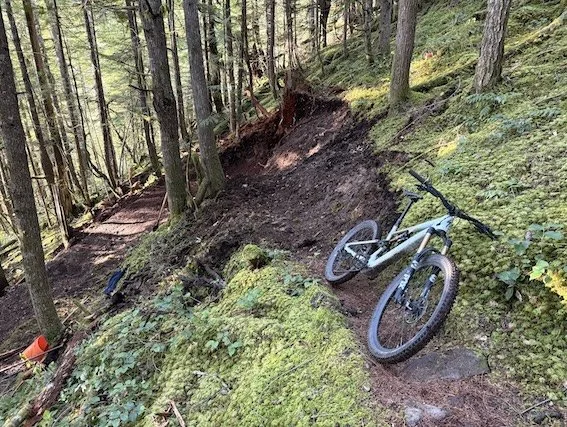
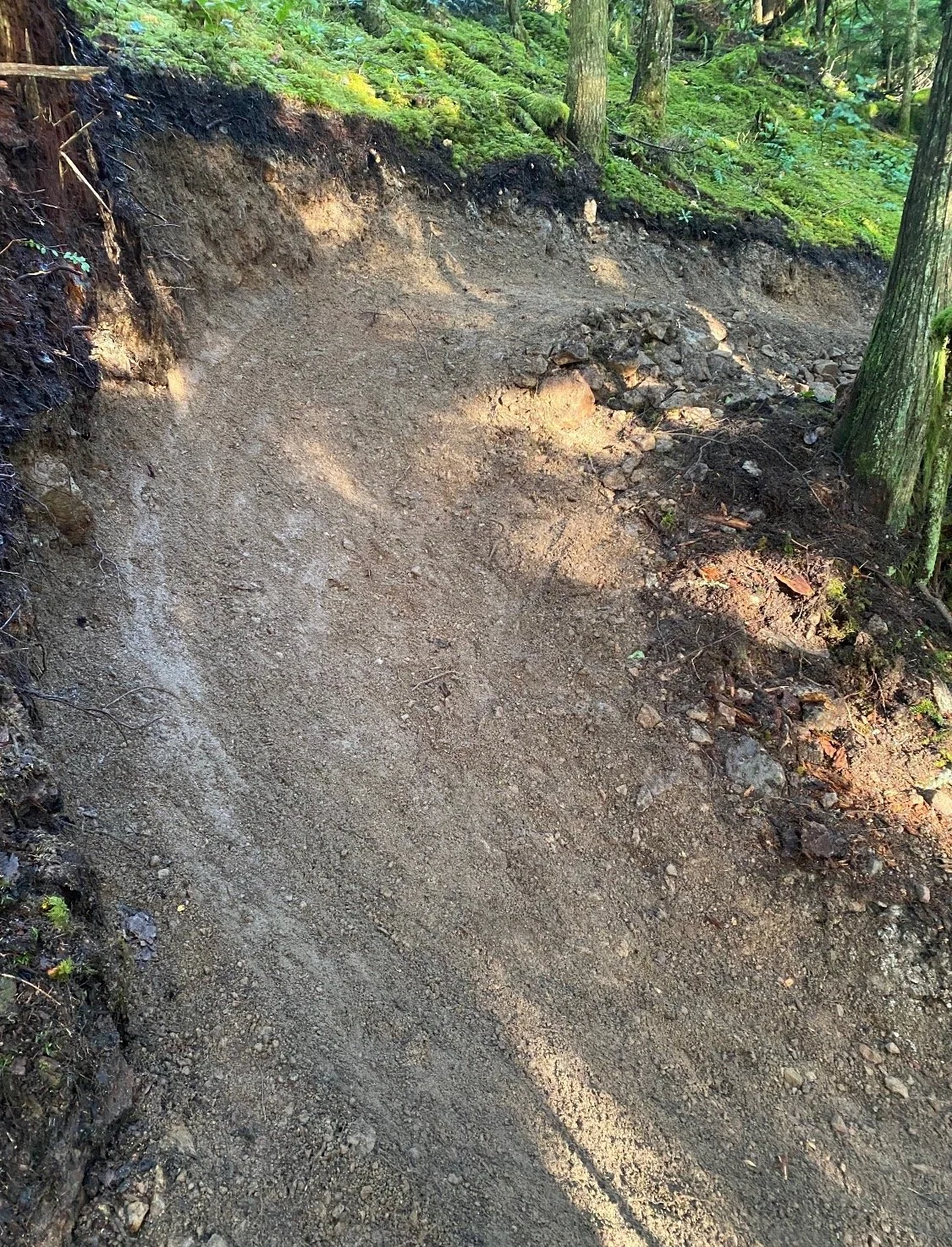
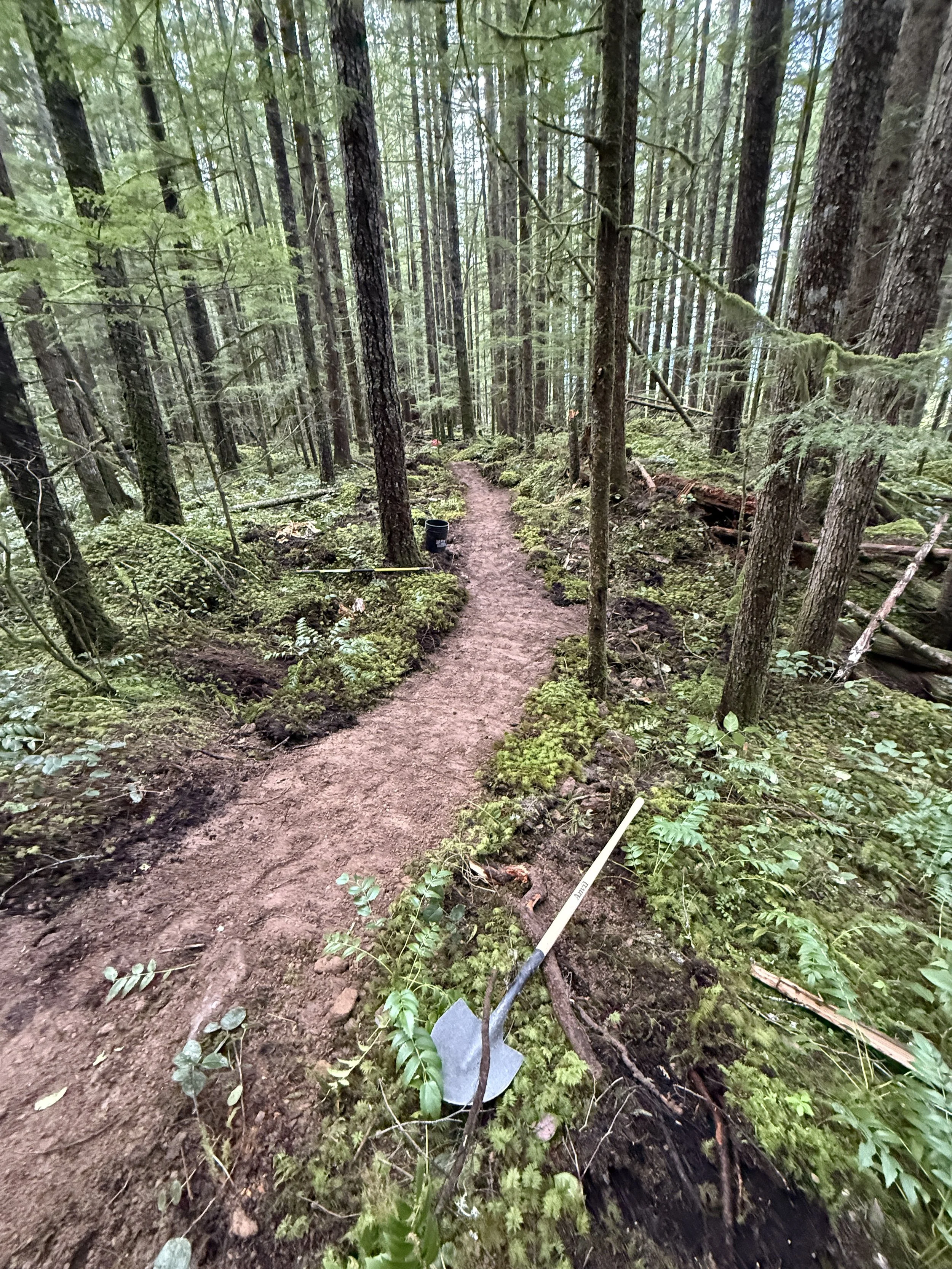
Work that occurred over the winter of 2025/2026
After the Race: Quiet Years and Steady Hands
Following the final Test of Metal in 2016, the Powerhouse Plunge entered a quieter chapter. As new trails were built using the access the Plunge had helped create, including Power-Hood Connector, Somewhere Over There, Hoods in the Woods, and others, rider volume on the original descent declined. The newer trails were more in tune with contemporary riding styles. The Plunge remained, but it no longer sat at the centre of Squamish riding life the way it once had.
Time did what time does to trails. The original capping dirt wore away. Bridges aged. Volunteer crews worked steadily to keep the trail rideable, each rebuild drawing on the same mixture of creativity and sweat that had built it in the first place. The Plunge endured, quietly, as it always had.
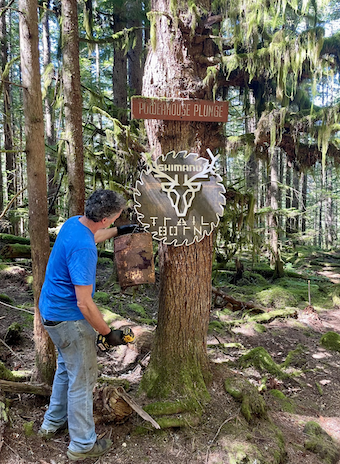


Above pictured is the Shimano Trail Born signs, designed and crafted by The Artiste & Sea to Sky Welding
Full Circle: The Refurbishment
In early 2025, SORCA began conversations with Shimano Trail Born about a substantive investment in the Powerhouse Plunge. The partnership made a kind of intuitive sense. Like the Plunge itself, Shimano has been part of mountain biking from its earliest days. And Shimano understands something that distinguishes the sport from road cycling: unlike road riding, where the terrain exists by default, mountain biking requires collective, ongoing effort to create and maintain the places where it happens. A trail is not found; it is made, and remade, by the people who care about it.
When SORCA’s board of directors chose Gravity Logic’s proposals to lead the two-phased refurbishment project, the circle closed in a way that few could have scripted. Gravity Logic, the bike park design firm co-founded by Rob Cocquyt, one of the original builders of the Plunge, would lead the trail’s renewal in 2026. Some of the same hands that had swung tools into volcanic rock three decades earlier would be back to do it again.
The Powerhouse Plunge is more than a trail. It is a record of everything Squamish mountain biking has been: the ambition of a small group who believed a community could build something great; the passion of riders who fought to protect it; the quiet dedication of volunteers who kept it alive. It is a reminder of when the first shovels broke ground, and a sport, a community, and a place found each other. The Plunge shaped Squamish. Squamish shaped the Plunge. The story isn’t finished yet.
The first half of the trail is completed at this time, and the full trail build is expected to be complete in Fall 2026.